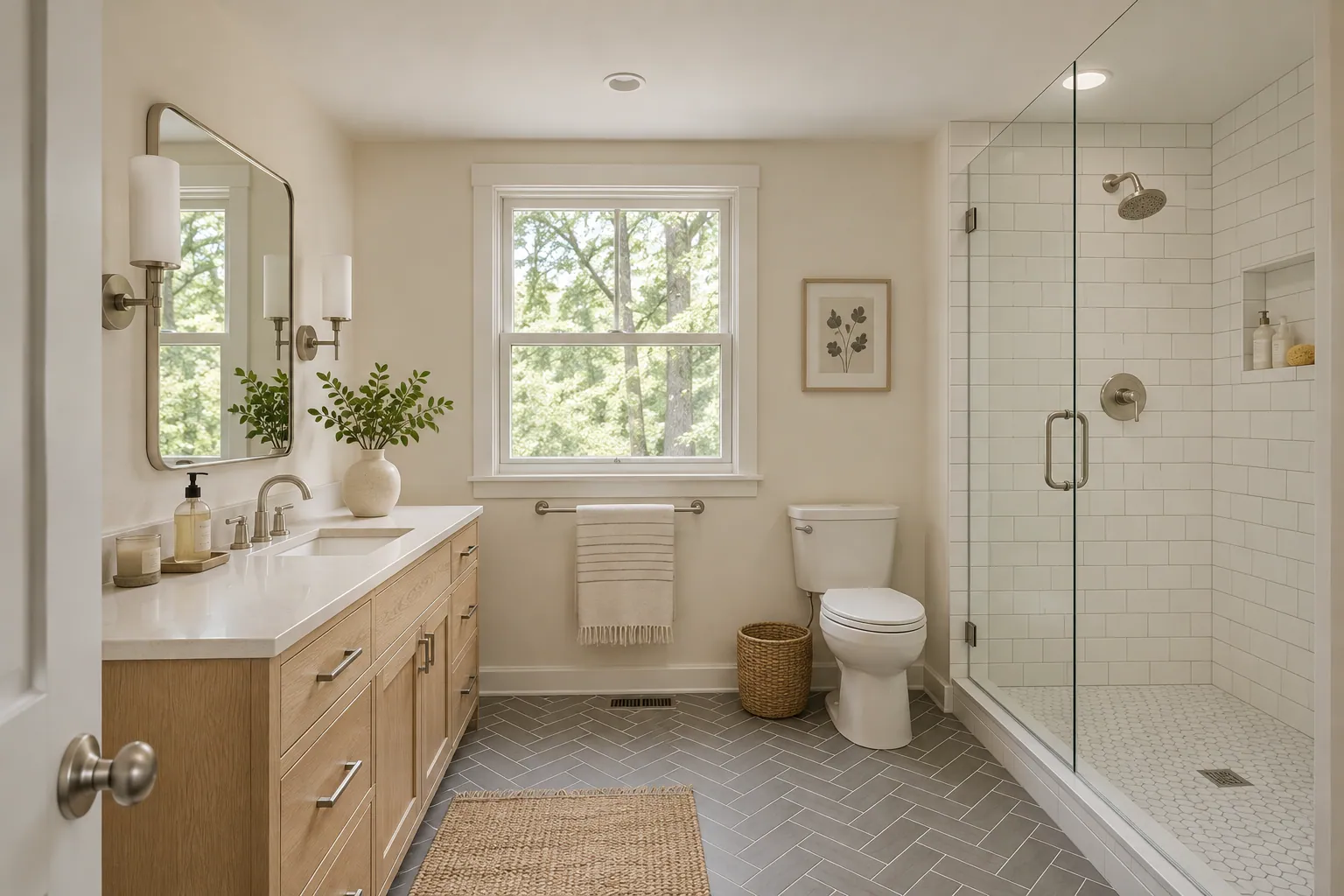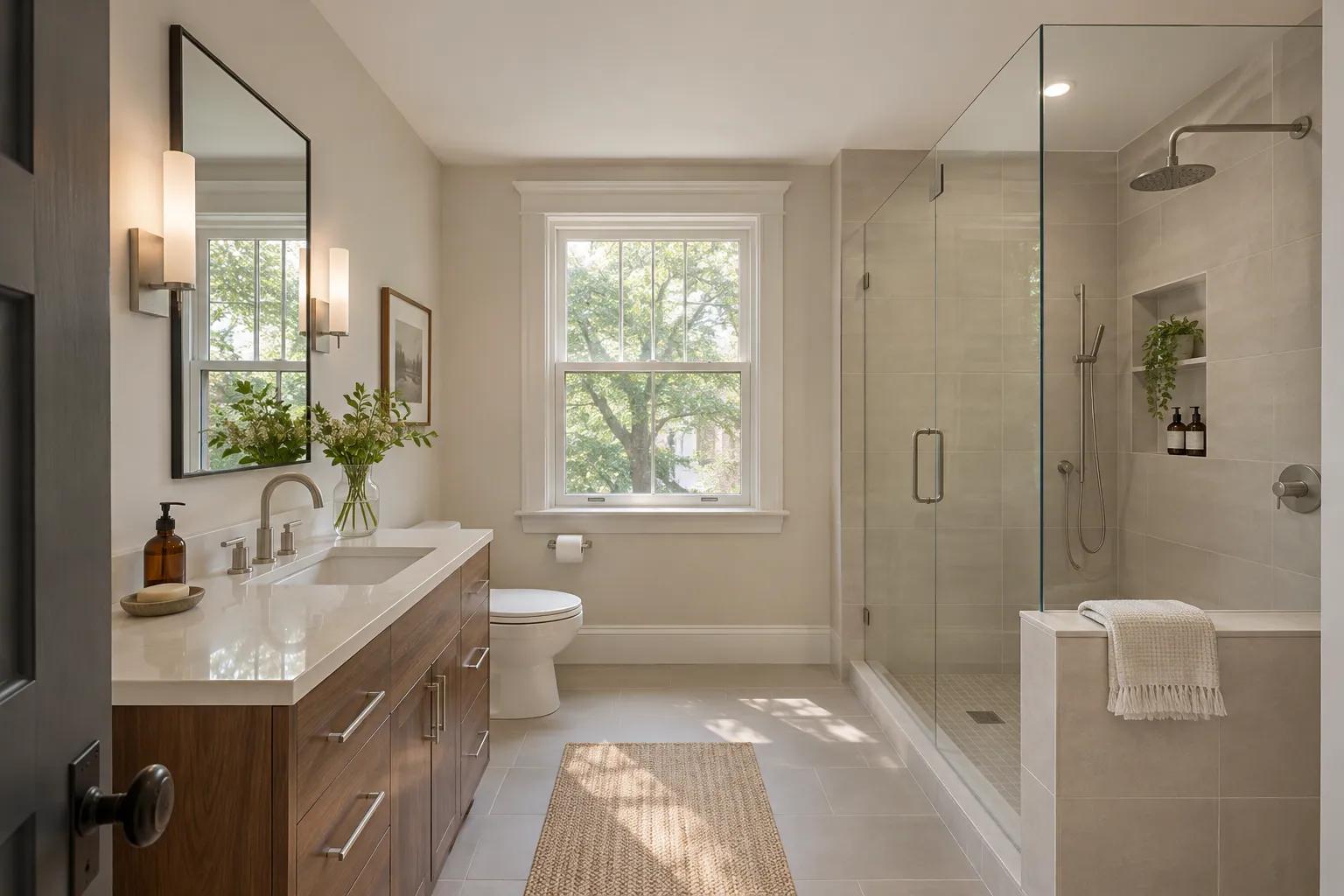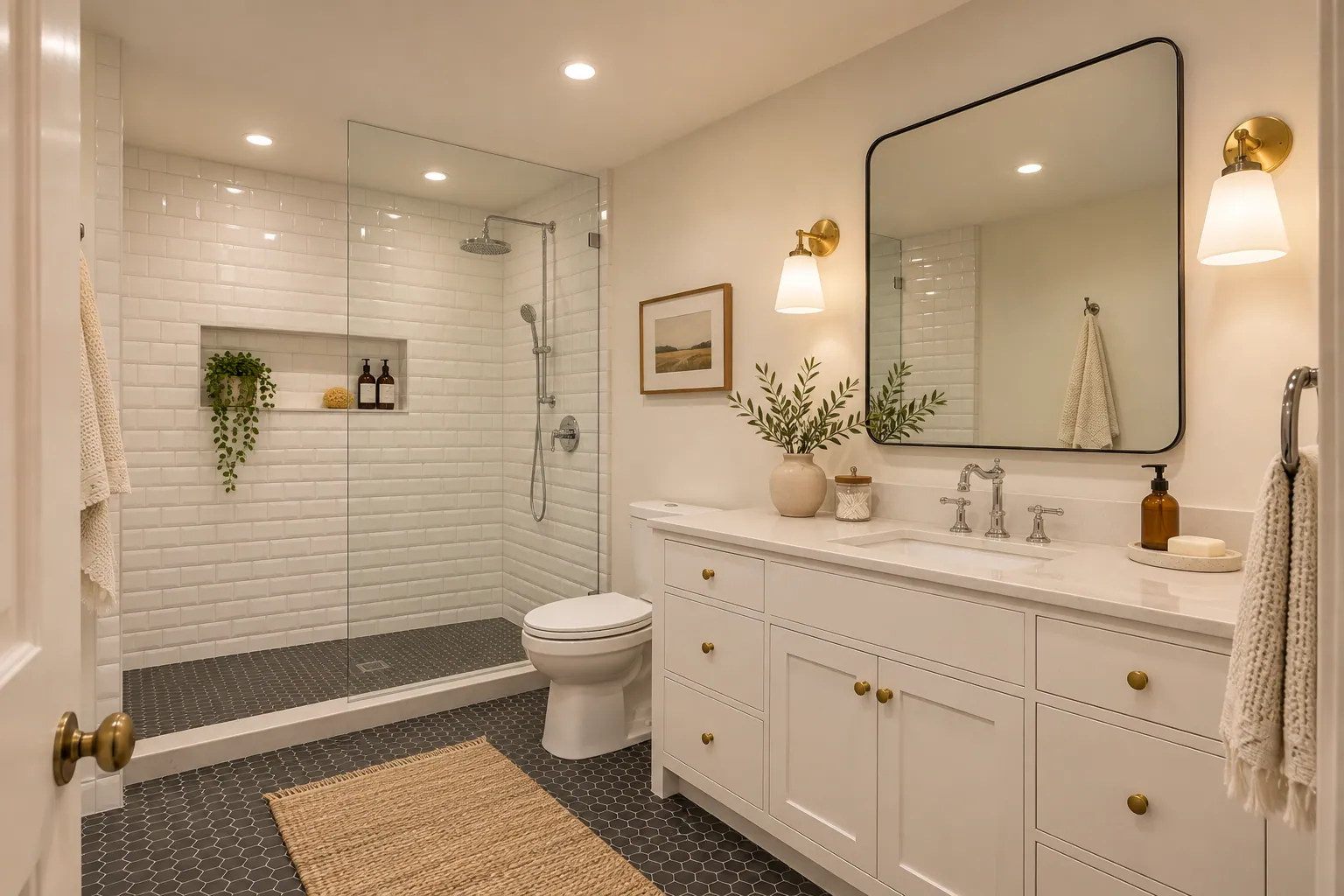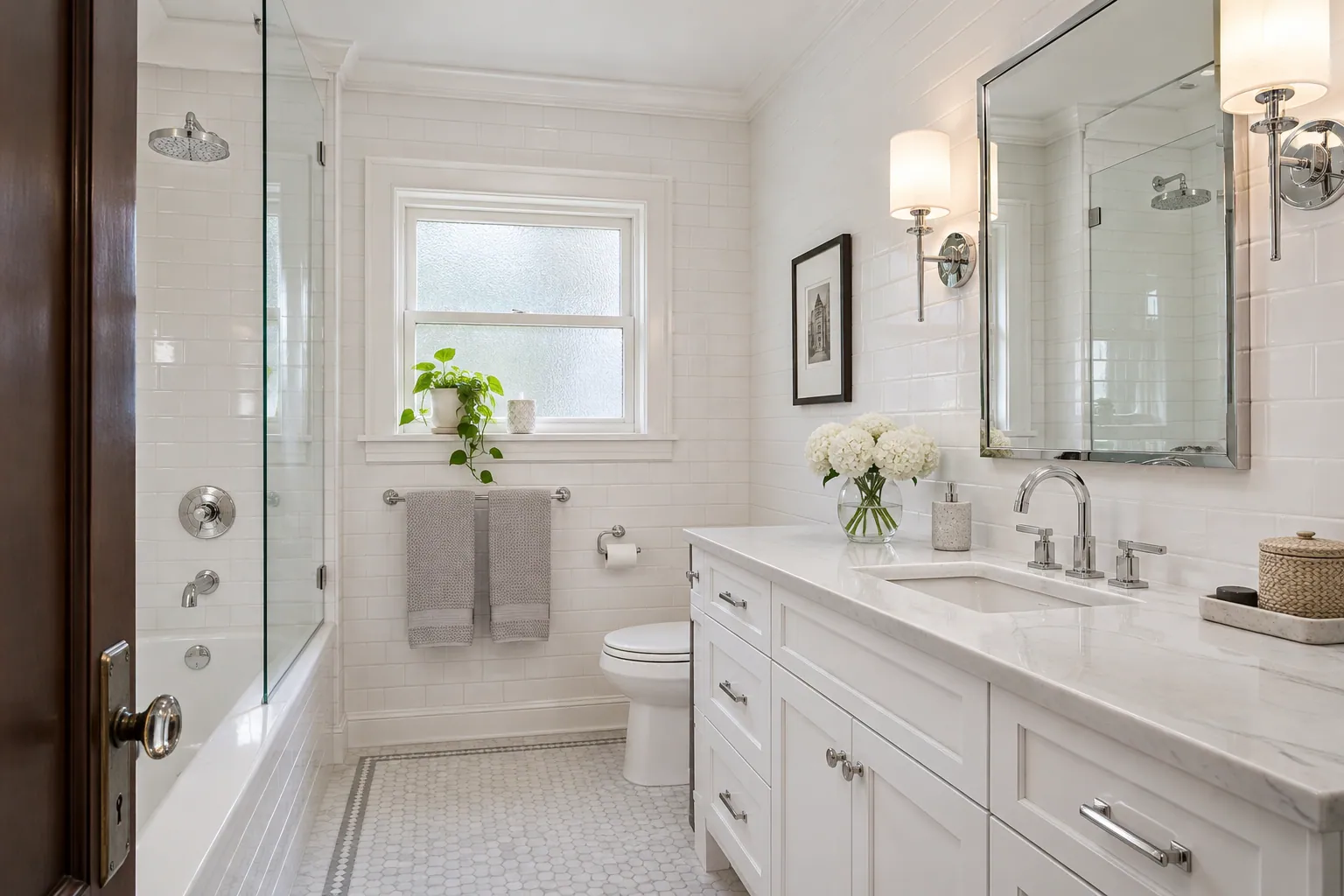
This guide to quartz vs marble bathroom countertops St. Louis homeowners ask about covers upkeep, cost, hard water and how each material behaves in an older brick home. Both look good, and both work. The right pick depends on how you use the bathroom and how much care you want to give the top.
Key takeaways
- Quartz is the easier choice for most hall baths and busy primary baths because it does not need sealing and resists stains and etching.
- Marble is a natural stone that etches and stains. It suits people who accept a lived-in look and will wipe up spills quickly.
- On a typical vanity top, the price gap is smaller than most people expect. The written quote for your exact size and edge is what counts.
- Both materials are fabricated to your vanity after it is installed, so plan the countertop into the schedule.
Quartz vs marble bathroom countertops St. Louis homeowners choose: the short answer
If you want a top you can mostly forget about, choose quartz. If you love the look of real stone and you are fine with a surface that changes over time, choose marble. That is the honest summary after years of seeing both in St. Louis bathrooms.
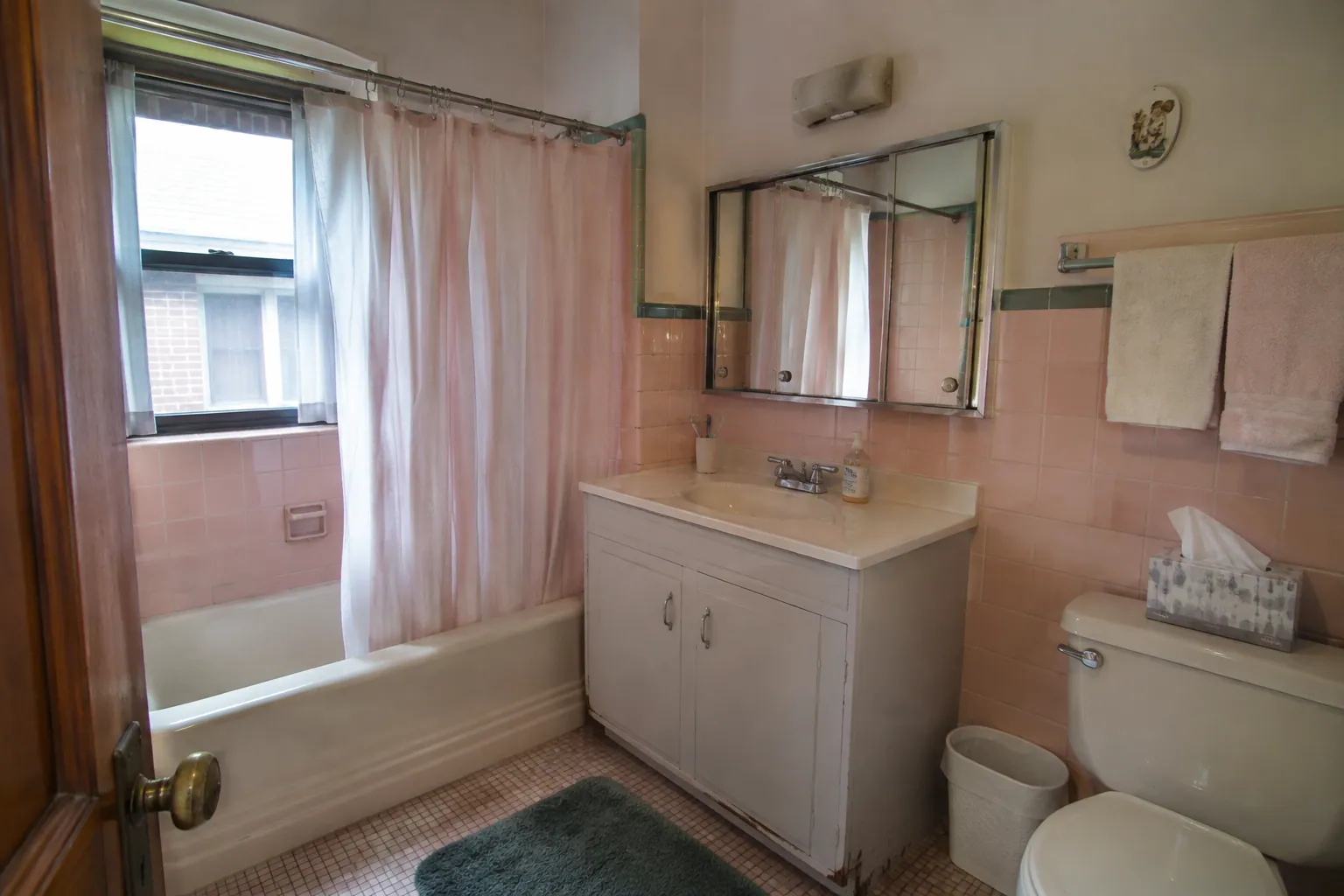
Most of our homeowners are in 1940s to 1970s homes and have been living with a laminate or cultured marble top for decades. After that, either material feels like a big step up. The question is really about habits, not looks.
How each material is made, and why it matters in a bathroom
Quartz countertops are engineered. They are made mostly of ground natural quartz bound with resin and pigment, then pressed into slabs. Because the surface is not porous, it does not absorb water, toothpaste, hair dye or makeup the way stone can.
Marble is cut straight from the earth. It is a calcium-based stone, and that is the key fact. Acids dissolve a little of the surface, so lemon, vinegar, some cleaners and certain bathroom products leave dull spots called etching.
Marble is also porous. A sealer helps, but it slows staining rather than stopping it. A drop of hair color or a ring from a bottle left overnight can leave a mark.
Quartz has its own limit, which is heat. The resin can scorch or discolor if you set a hot curling iron or flat iron directly on it. A heat-safe tray solves that.
Quartz vs marble at a glance
| Factor | Quartz | Marble |
|---|---|---|
| Material | Engineered, mostly ground quartz with resin | Natural stone |
| Staining | Highly resistant | Can stain, even when sealed |
| Etching from acids | Resistant | Etches easily, especially polished |
| Sealing | None needed | Sealing recommended on a schedule |
| Heat from styling tools | Can scorch the resin, use a tray | Handles heat better |
| Hard water spots | Wipe off easily | Can leave haze on polished finish |
| Typical vanity top cost | Often $500 to $1,800 installed | Often similar, higher for rare slabs |
| Look | Consistent, many marble-look options | Unique veining, develops a patina |
Hard water, humidity and cold exterior walls
Our water in the St. Louis area is hard. It leaves mineral spots around the faucet and along the back edge of the sink. On quartz, those spots wipe off with a damp cloth or a mild cleaner. On polished marble, the same spots can leave a haze, and the wrong descaler can make it worse.
Summers here are humid, and many older bathrooms have weak fans or none at all. Neither stone nor quartz grows mold on its own surface, but moisture sitting at the caulk line and the backsplash joint can. Keep the caulk fresh and run the fan during and after showers.
Cold winters matter too. Bathrooms on exterior walls in brick bungalows can stay cool and damp. That is another reason to pay attention to the seams and the sealed edges behind the faucet, whichever material you pick.
If your bath has an older vanity against plaster walls, expect the installer to deal with walls that are not perfectly flat. A good fabricator scribes the top to the wall, and a bead of caulk handles the rest.
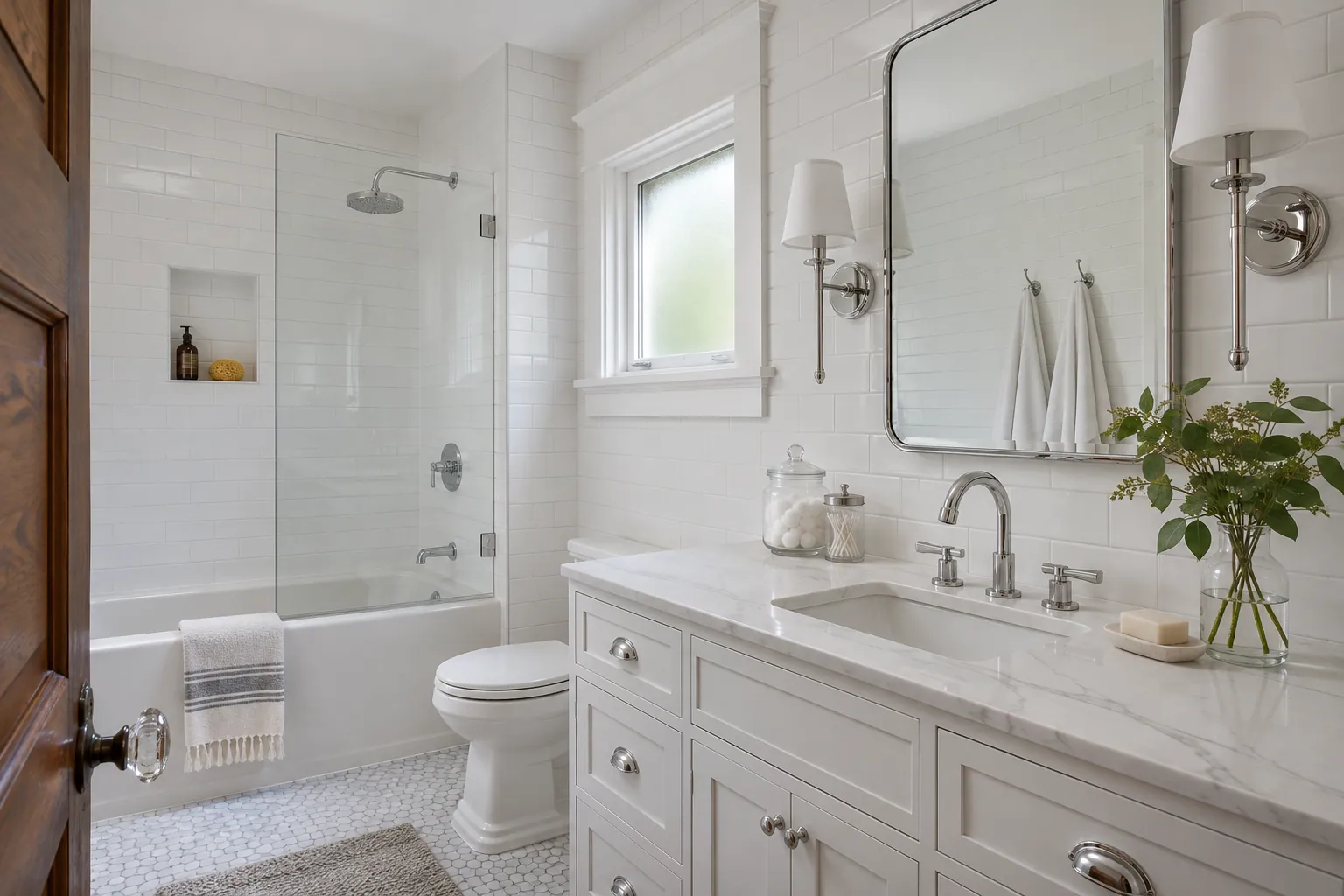
Staining, etching and daily upkeep
Quartz needs nothing more than soap, water and an occasional non-abrasive cleaner. There is no sealing schedule. Avoid harsh solvents and strong paint removers, which can dull the finish.
Marble asks more of you. Most people seal it when it is installed and again as the installer or fabricator recommends. Cleaners should be pH neutral and made for natural stone. Standard bathroom sprays are often the culprit behind dull spots.
A honed, or matte, marble finish hides etching much better than a polished one. Many homeowners who love marble choose honed for this reason. It looks softer and more natural, and small marks blend in.
Some people embrace this. Marble develops a patina, and in an older home that can look right. Others find every mark bothersome. Be honest with yourself about which person you are.
- Quartz: wipe daily, no sealer, use a trivet for hot tools.
- Marble: wipe spills fast, use stone-safe cleaners, reseal on a schedule, expect some etching.
- Both: keep caulk at the backsplash and sink rim in good shape.
What each costs on a typical vanity top
A bathroom vanity top is small, so the cost difference between materials is smaller than it would be on a kitchen. Most quartz vanity tops in the St. Louis area typically land between about $500 and $1,800 installed, depending on width, edge profile, sink cutouts and the slab you choose. Marble often runs in a similar range, and rarer or more dramatic slabs can push it higher.
Those numbers move with slab choice, whether you use a remnant, and whether the top has a full backsplash or a side splash. A 36-inch top for a hall bath is a very different job from a 72-inch double-sink top in a primary bath.
Treat these as ballpark figures only. Your written quote is what counts, and it should list the material, the edge, the sink cutouts, the faucet holes and the removal of the old top.
Which material fits which St. Louis bathroom
In a small 5x8 hall bath, where kids, grandkids or guests use the sink every day, quartz is usually the better fit. It handles toothpaste, cosmetics and quick cleanups without fuss. A lighter quartz also helps a small room feel open.
In a primary bath in a 1950s ranch or a split-level, either one works. If you share the bath and nobody is gentle with products, lean quartz. If it is mostly yours and you like the look of stone, marble can be a good choice.
In a powder room or guest bath that sees light use, marble is the easiest place to take a chance. There are fewer products, fewer spills and less moisture.
In a basement bath, think about humidity first. Quartz is a safe, stable choice there, and it pairs well with moisture-resistant cabinets.
If you are aging in place, quartz in a medium tone with a rounded edge is practical. Glare from very glossy polished stone can be hard on older eyes, and a honed or matte finish helps either way.
Getting the marble look without the upkeep
Many quartz lines now carry white and gray veined patterns that read as marble from a few feet away. They are not identical to real stone, since the veining repeats in a more controlled way, but they come close. For a lot of homeowners this is the best of both.
If you want true marble, a few choices cut the risk. Go with honed rather than polished, keep the sink area clear of bottles, and use a tray for soaps and lotions. A smaller top also means fewer places for things to go wrong.
Another option is to use marble somewhere it is less exposed, such as a shower niche shelf or a floor border, and use quartz on the vanity. We can show you samples side by side so you can judge the look in your own light.
What to expect when the countertop is installed
Neither material is cut on site to final size. After the vanity is set, the fabricator measures the exact top, then cuts and polishes it in the shop. Lead times vary with the slab and the shop schedule, so ask for a date range in writing.
On a full remodel, the vanity and countertop are part of the 2 to 4 week schedule. On a smaller update, a replacement top can often be swapped without redoing the whole bathroom, as long as the vanity base is sound.
Our installers are licensed and insured. If plumbing has to move, permits go through St. Louis County or the city or municipality where required, and we handle that. Old shutoff valves and supply lines are worth replacing while the top is off.
The bottom line
The best way to settle quartz vs marble is to see both in your own bathroom light, next to your tile, your vanity and your walls. Samples look different at home than in a showroom. During a free in-home or video design visit, we measure the space, talk through how your household uses the bath, and put the options in a written quote. You can compare materials, edges and costs side by side, with no pressure to decide that day. If you are also thinking about a new vanity, tile or a shower update, we can price it all together.